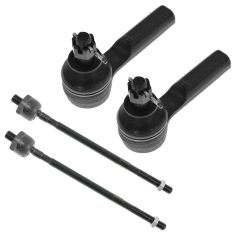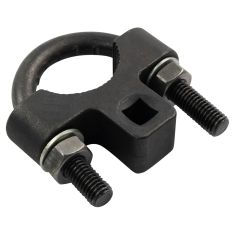
Replaces


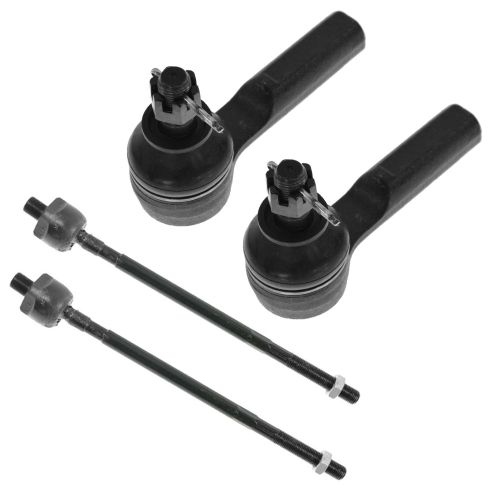
Frequently bought together
Part Details
About TRQ:
TRQ is a trusted brand dedicated to making every repair a success story by combining premium parts with easy installation. Each TRQ part is engineered by a team of automotive experts to meet or exceed OEM standards, delivering enhanced performance and maximum longevity. With rigorous in-house testing, the brand ensures superior fit and function across every product line. TRQ also provides customers with best-in-class, step-by-step installation videos—so you can complete repairs with confidence, whether you're a first-time DIYer or an industry professional.
Install Tip: When replacing steering components, have a professional alignment performed afterwards. This ensures proper tracking and even tire wear.
Our steering and suspension components are pre-greased and sealed for long life and do not require the extra maintenance typically required by greaseable versions.
Attention California Customers:
 WARNING: This product can expose you to chemicals including Lead and Lead Compounds, which are known to the State of California to cause cancer, and birth defects or other reproductive harm. For more information, go to www.P65Warnings.ca.gov.
Lifetime Warranty
This item is backed by our limited lifetime warranty. In the event that this item should fail due to manufacturing defects during intended use, we will replace the part free of charge. This warranty covers the cost of the part only.
FREE Shipping is standard on orders shipped to the lower 48 States (Contiguous United States). Standard shipping charges apply to Hawaii and Alaska.
Shipping is not available to a P.O. Box, APO/FPO/DPO addresses, US Territories, or Canada for this item.
Expedited is available on checkout to the United States, excluding Alaska, Hawaii.
Final shipping costs are available at checkout.

Created on:
Tools used
Brought to you by 1AAuto.com, your source for quality replacement parts and the best service on the Internet.
Hi, I'm Don from 1A Auto. I hope this how-to video helps you out, and next time you need parts for your vehicle, think of 1AAuto.com. Thanks.
In this video, we're going to show you how to replace the right hand outer tie rod on this 2003 Nissan Maxima. Obviously the left hand is the same procedure. This is the same for any 2000-2003 Maxima as well as the Infiniti I30.You'll need a new tie rod from 1aauto.com, jack and jack stands, 15-21 mm sockets. You'll need a ratchet and probably a breaker bar or a pipe for some extra leverage, pliers, a large hammer, penetrating oil, as well as you will, or we recommend, you get an alignment after you replace a steering component like this.
Let's start off by removing the wheel. You're going to want a 21 mm socket and ratchet or breaker bar or your tire iron and you'll probably want to start with the wheel on the ground, loosen the lug nuts, then raise and secure the vehicle with jack stands, and then remove the wheel and the tire.
At this point we're going to measure the distance between the end of the boot and the center of the top of the tie rod. It's roughly 11 and 3/4 inches. Yours might be different. It's always a good idea to use some penetrating oil on the lock nut. Spray that down and let it soak in. With our adjustable wrench, size up the nut holding on to the end of the tie rod, with a 13 mm open ended wrench holding the inner tie rod and free it up. Move the steering wheel to the right to gain better access. We're going to remove the securing cotter pin through the outer tie rod. We're just going to speed it up here as Don tries to get that cotter pin out. We couldn't get the cotter pin fully out, so we're going to use our 19 mm, 1/2 inch wrench and then try and sheer it. In this case we're going to use a little extra leverage with the bar on the end of our wrench. I'll speed it up here as we work that bolt the rest of the way off. Quick summary: we tried to get the cotter pin out. It just wouldn't come out. It was basically frozen in there so what we did is took the pliers and broke the ends off as much as we could and then just got the socket on there and sheered the cotter pin right off by moving the bolt.
To help release the outer tie rod from the spindle we use a hammer and hit against the spindle until it frees up. Now it's free. Pull the inner tie rod with your 14mm wrench and twist off the outer tie rod. OK, speed up and Don did misspeak a little bit there: he is using a 13 mm wrench to hold that tie rod.
We got the old outer tie rod and the new one and you can see that dimensionally they're very close, so when they go back in the alignment should be relatively close to what it was before we removed it. It's always a good idea to put a little anti-seize on the end of your inner tie rod so that if you ever have to replace it again, it'll come off just as easily as this did. Holding the inner tie rod, twist the new tie rod on. Check our length from the end of the boot to the center of the tie rod and it is 11 and 3/4 inches just like it was when we took it out. Place the other tie rod back into the spindle. It can be a little stiff. Now we'll secure the nut and set our torque wrench to 55 foot pounds and we're going to torque the nut. Now what you do is make sure that the hole in the outer tie rod matches the slot or one of the slots on the nut and if it doesn't, giving it a little bit more torque is acceptable to the point where the cotter pin slides through the outer tie rod. Bend the ends that come through back along the side of the nut. With the 13 mm wrench hold your inner tie rod and lock down on the nut. Fast forward here as we take that lug nut back off, put the wheel and tire on, and just put the lugs on by hand first and then preliminarily tighten them. Set your torque wrench to 100 foot pounds and tighten the lug nuts. Use a star pattern. Kind of draw a star pattern as you tighten them and then just recheck them.
We hope this helps you out. Brought to you by www.1AAuto.com, your source for quality replacement parts and the best service on the Internet. Please feel free to call us toll-free, 888-844-3393. We're the company that's here for you on the Internet and in person.
Tools used
Brought to you by 1AAuto.com, your source for quality replacement parts and the best service on the Internet. Hi. I'm John from 1A Auto. I hope this how-to video helps you out, and the next you need a part for your vehicle, think of 1AAuto.com. Thanks. In this video, we show you how to replace an outer tie rod on this 2003 Nissan Altima, and it's the same process on these Altimas from 2002 to 2006, and we show you on the passenger's side; however, it is the same process on the driver's side. The items you'll need for this is a new outer tie rod from 1AAuto.com, a 22-mm or 7/8-inch wrench, a 7-, 19-, and 21-mm sockets and ratchet, tape measure, pliers, and jack and jack stands. Start off by removing the wheel. If you don't have air-powered tools, you're going to want to loosen the lug nuts while the vehicle is on the ground. Then, jack it up and remove them the rest of the way.
First, measure from your inner tie rod to the end of your outer tie rod and remember that length. Next, you want to remove the cotter pin from this castle nut, and ours is in such bad shape that we actually just break it off, but what you should do is just pull it from the other side with a pair of pliers and pull it out. We just don't have that option. Once you have it removed, you want to remove this 19-mm castle nut. Then, using your 22-mm or 7/8-inch wrench, you want to just break this loose. Now, use a hammer and hit the knuckle to break the outer tie rod free, and then, it just lifts up and out, and you can just twist it off. On the right is the old outer tie rod. On the left is a new one from 1A Auto. You can see they're identical, and they'll mount exactly the same. Twist in this grease fitting, and just tighten it up. It's a 7-mm socket to do this. Then, twist your new outer tie rod into place. Then, put it into place in the knuckle, and replace that 19-mm castle nut and just tighten that up.
Now, you want to measure from your inner tie rod to the edge of the outer and make sure it's the right distance, and if it is, then you just want to tighten that nut up. If the distance needs to be adjusted, just turn the inner tie rod to get it correct, and you will want to have, if your vehicle doesn't steer correctly at all, you'll want to have your alignment checked and adjusted after this repair. Push your cotter pin through and just bend the ends of it. Replace your wheel, hubcap, and lug nuts, and tighten the lug nuts preliminarily, lower the vehicle, and tighten them the rest of the way. Then, you want to torque the lug nuts in a crossing pattern to 100 foot-pound. We hope this helps you out. Brought to you by 1AAuto.com, your source for quality replacement parts and the best service on the Internet. Please feel free to call us toll free 888-844-3393. We're the company that's here for you on the Internet and in person.

PSA55440