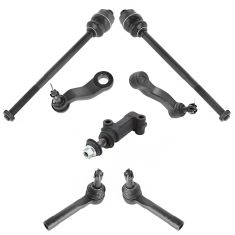
Replaces



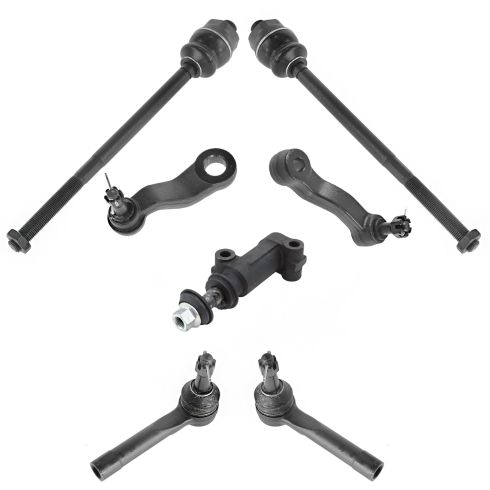


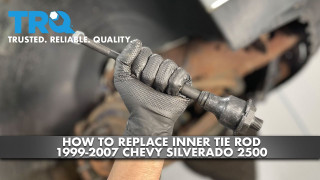

Frequently bought together
Part Details
About TRQ:
TRQ is a trusted brand dedicated to making every repair a success story by combining premium parts with easy installation. Each TRQ part is engineered by a team of automotive experts to meet or exceed OEM standards, delivering enhanced performance and maximum longevity. With rigorous in-house testing, the brand ensures superior fit and function across every product line. TRQ also provides customers with best-in-class, step-by-step installation videos—so you can complete repairs with confidence, whether you're a first-time DIYer or an industry professional.
Product Features
TRQ suspension kits are manufactured using premium raw materials and coatings for extended service life. Each TRQ suspension component is designed to be a direct, maintenance-free replacement to the stock unit. To extend the life of your steering and suspension components, TRQ recommends replacing components in pairs, sets, or kits. All products are fit and road-tested in our Massachusetts R&D facility to ensure we deliver on our promise of Trusted Reliable Quality.
Install Tip: When replacing steering components, have a professional alignment performed afterwards. This ensures proper tracking and even tire wear.
Our steering and suspension components are pre-greased and sealed for long life and do not require the extra maintenance typically required by greaseable versions.
Attention California Customers:
 WARNING: This product can expose you to chemicals including Lead and Lead Compounds, which are known to the State of California to cause cancer, and birth defects or other reproductive harm. For more information, go to www.P65Warnings.ca.gov.
Lifetime Warranty
This item is backed by our limited lifetime warranty. In the event that this item should fail due to manufacturing defects during intended use, we will replace the part free of charge. This warranty covers the cost of the part only.
FREE Shipping is standard on orders shipped to the lower 48 States (Contiguous United States). Standard shipping charges apply to Hawaii and Alaska.
Shipping is not available to a P.O. Box, APO/FPO/DPO addresses, US Territories, or Canada for this item.
Expedited is available on checkout to the United States, excluding Alaska, Hawaii.
Final shipping costs are available at checkout.
Created on:
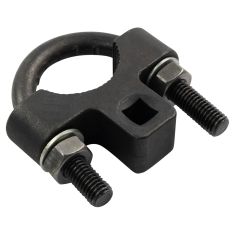
Tools used
Brought to you by 1AAuto.com, your source for quality replacement parts and the best service on the Internet.
Hi, I'm Don from 1A Auto. I hope this how-to video helps you out, and next time you need parts for your vehicle, think of 1AAuto.com. Thanks.
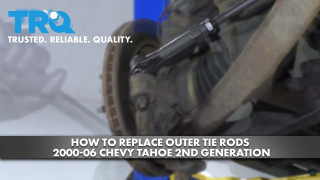
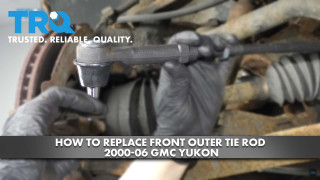
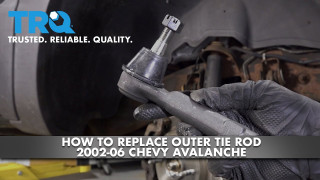
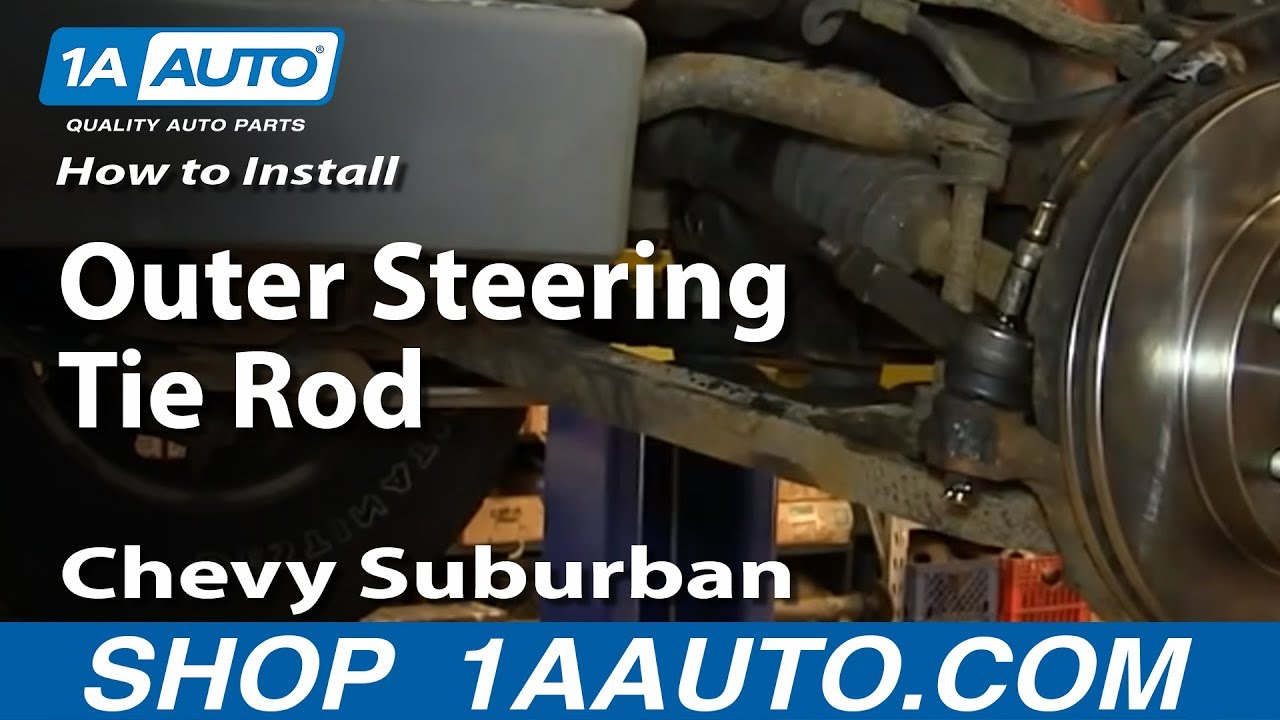
In this video, we're going to show how to replace an outer tie rod on this 2002 Chevy Suburban, and it's the same part and similar process on these Suburbans from 2001 to 2006. We show you on the passenger side, but the driver side is the same procedure. The items you'll need for this are a new outer tie rod from 1AAuto.com; 7mm, 13mm, 18mm and 22mm socket and ratchet; flat-blade screwdriver; adjustable wrench; tape measure; pliers; hammer; and a grease gun.
You want to just loosen up these 22mm caps, and then pull the hubcap free. Then, you want to loosen these lug nuts while the vehicle is on the ground, then raise the vehicle and remove them the rest of the way, unless you have air-powered tools. Then, you can do it while it's in the air.
Now you want to measure from the boot on your inner tie rod to the edge of your outer tie rod and just remember that measurement. Now, using your adjustable wrench, loosen up this nut right here, and then you want to remove this 18mm nut down here. Now just hit on your knuckle with a hammer and this is going to break up that outer tie rod and make it easier to pull out. Now just hold this nut with the adjustable wrench, pull the outer tie rod off and just twist it until it comes free. We'll fast forward as Don does this. You want to make sure that the inner tie rod doesn't spin while you're removing the outer tie rod.
Now, put the grease fitting into your new outer tie rod and just tighten that 7mm grease fitting up. Then twist the outer tie rod back onto your inner tie rod and push it down into place. Now, replace the castle nut and just tighten that up. Then push the cotter pin through and, using your pliers, just bend the ends of it. Now, using your grease gun, fill the tie rod with grease. Measure, and you should get about the same distance. That's a good preliminary alignment. You should have your car aligned after this. Tighten up the lock nut to hold it in place.
Now replace your wheel and then replace those lug nuts and tighten them preliminarily. Lower the vehicle and tighten them the rest of the way. Now torque the lug nuts in a crossing pattern to 100 foot-pounds. Replace the hubcap and tighten up those caps.
We hope this video helps you out. Brought to you by www.1AAuto.com, your source for quality replacement parts and the best service on the Internet. Please feel free to call us toll-free, 888-844-3393. We're the company that's here for you on the Internet and in person.
Tools used
Hi, I'm Mike from 1AAuto. We've been selling auto parts for over 30 years! We're dedicated to delivering quality auto parts, expert customer service, and fast and free shipping, all backed by our 100% satisfaction guarantee. We've created thousands of videos to help you install our parts with confidence. That saves you time and money, so visit us at 1AAuto.com, your trusted source for quality auto parts.
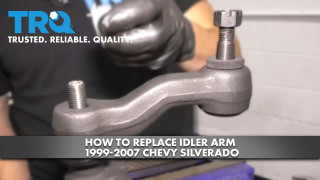
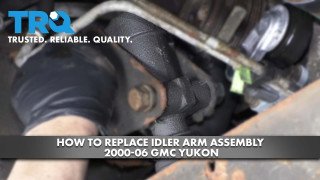
All right, to find the idler arm on your truck—it's on the passenger side—is to start at the tie rod end and just follow the arm all the way to your inner tie rod and then up to your idler arm. The idler arm is on the passenger side, and it bolts to the frame of the vehicle and to the steering itself. You can watch the play in it by just moving the tire back and forth forcefully with your hand. There shouldn't be any sort of play in between the idler arm and the steering shaft itself. That is actually the problem here. The vehicle failed inspection because there's too much play here. It's actually to a point where it's actually becoming dangerous, because this is actually going to break apart pretty soon. We want to get in here and replace the idler arm.
The first step to removing the idler is removing the cotter pin that holds the nut in place. I think to use a pair of cutters to grab it with. It's usually the easiest thing to do, although I may prove myself wrong. There we go. Then you can also use a pair of locking pliers to pull it from the other side. Then you'll take your 21-millimeter socket with an extension, and I'm using a 1/2 inch ratchet because it's going to be pretty tight, and we'll crack it loose. Luckily it's greasy, so once you crack it loose it usually spins right off.
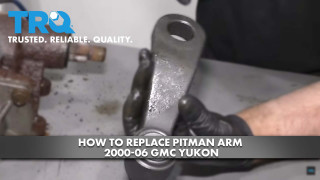
Ideally, you want to have a puller, which you can get from your local hardware store or auto parts store. You can usually rent them. You'll want to put it on like this. We're using a two jaw puller. It wraps up on both sides of the steering arm, and then the center bolt pushes right on the idler arm. Then in our case it's a 16-millimeter right here, but depending on the puller it could be a different size. At that point, you want to just tighten up your puller until the idler arm breaks free. We're going to be pulling off the idler arm with the idler arm bracket, so we need to take out the lower nut right here and then the upper one right up here.
In New England, we like to spray everything with rust penetrator because we take it off because it just makes life a lot easier. On the front side of the bracket, there's the actually heads of the bolt that we're going to put a socket on. Right here is the lower one. Then up here is the upper one. We're going to use a 21-millimeter with an extension and a little wobble adapter so that we can get on there. It's not the easiest thing to reach, but once you're on there it should stay there. Then on the backside we'll put a wrench to hold the nut in place, and hopefully turn it.
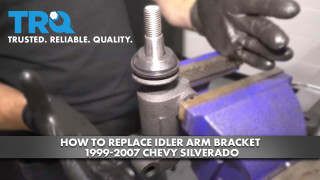
Now we're heading for the top bolt on the idler arm bracket. We have our 21-millimeter wrench on the backside and then 21-millimeter socket and extension on the front. At this point, we'll be able to just pull the whole idler arm and its bracket right out of the truck like so. With the idler arm off the truck, we put it in a vice, and you can see how much movement there is in it. There obviously shouldn't be any. That should be nice and tight.
We've cleaned up our idler arm and idler arm bracket. Both are well used, but we're going to show you how to separate the idler arm from the bracket itself. In our case, there's a 24-millimeter nut on here. That may differ depending on if your car has an original OEM part or if it's been replaced before. In our case, it's 24-millimeter. We're going to throw it in the vice and put our 24 millimeter socket on with a 1/2 inch ratchet because you want plenty or torque, and hopefully we can crack this loose. With the nut off, now we have to pull the idler arm off the idler arm bracket.
Once again I'm going to reposition this in the vice. Get a puller, which you can rent from a local hardware store or an auto parts store, or they're actually not too expensive if you just buy them and you think you might be doing this more than once. It might be worth buying a kit to do this. Then you'll tighten down the center bolt. In our case, we have a 16-millimeter on the top of the puller, which we will once again use our 1/2 inch ratchet to tighten up. You always want to wear your safety glasses when you're doing these things, safety gloves, because things tend to spring off when you're least expecting it, kind of like that. Now that it's broken loose, you can pull it right off.
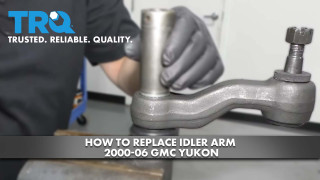
Here are the idler arms. You can see the old one right here. This one has a ton of play in this section. I think it's probably due to the fact that somebody didn't grease this on a regular basis. Usually, if you put the grease in and then forget about it for the next 100,000 miles, it's going to wear out the inside, and you're going to need to replace the whole thing again. This one obviously comes with a new greaseable fitting on the top. The key is you just want to make sure that you properly grease these on a regular basis, and it'll pretty much last as long as you take care of it. It also does come with a little foam piece on the bottom like the original has. Yeah, it looks, feels, and acts just like the original.
In our case, we're going to be replacing the idler arm bracket and the idler arm, and this is the same process, whether you're replacing one or the other, but we always recommend doing them both at the same time since you have them both out of the vehicle. It's just a really easy thing and it doesn't cost a whole lot more, or a whole lot more money to swap them both at the same time. To do this, we'll hook the idler arm bracket into the vice and we'll slide the idler arm right onto the bracket. Put the nut on there. This happens to be a 24-millimeter. Depending on what kind of part you have in your car, it may vary. The size may vary a little bit.
At this point, we can tighten this up. We started tightening the nut, and we found that the whole thing was spinning, like you can see here. That's why they put a hex on the top of this, so that you can put a wrench here and a wrench on the bottom, and then you can tighten down the nut much easier. While the idler arm bracket and idler arm are out of the vehicle, we're going to put the grease in them. That way it's a little bit easier on us once they're installed. Now we can slide the whole assembly right back in. There's one bolt in place. Now we'll do the lower bolt, which is a little trickier.
All right, with the top, or with the idler arm bracket bolts in place, then you can push the idler arm into the steering and tighten up the castle nut, or hand tighten the castle nut. Now we're going to take our 21-millimeter socket and extension and place it on the upper bolt and put a wrench on the backside. Of course, we want to turn the ratchet in the proper direction, and we'll start tightening up that bolt. All right, then we'll go for the lower one, which again 21-millimeter with a ratchet and extension and 21-millimeter on the back.
Now we have the 21-millimeter idler arm nut that we are going to use a ratchet and extension and socket on. We want to get it tight enough so that it is held in place, but we also want to line up the castle nut with the hole in the idler arm so that we can get the cotter pin through. Now you can slide the cotter pin through the hole and bend it over so that it stays in place. Now you'll see that when we move the wheels back and forth, the play between the idler arm and the steering bracket no longer exists.
Thanks for watching. Visit us at 1AAuto.com for quality auto parts, fast and free shipping, and the best customer service in the industry.
Tools used
Hi, I'm Mike from 1AAuto. We've been selling auto parts for over 30 years! We're dedicated to delivering quality auto parts, expert customer service, and fast and free shipping, all backed by our 100% satisfaction guarantee. We've created thousands of videos to help you install our parts with confidence. That saves you time and money, so visit us at 1AAuto.com, your trusted source for quality auto parts.
You can replace the idler arm bracket by itself. To find the idler arm on your truck, in this case it's on the passenger side, but another easy way is to start at the tie rod end and just follow the arm all the way to your inner tie rod, and then up to your idler arm.
The first step to removing the idler is to remove the cotter pin that holds the castle nut in place. I like to use a pair of cutters to grab it with. It's usually the easiest thing to do, although I may prove myself wrong. There we go. And then you can also use a pair of locking pliers to pull it from the other side. Then you'll take your 21mm socket with an extension, and I'm using a 1/2" ratchet, because it's going to be pretty tight, and we'll crack it loose.
Luckily it's greasy, so once you crack it loose, it usually spins right off. So, ideally you want to have a puller, which you can get from your local hardware store or auto part store. You can usually rent them. And you'll want to put it on like this. We're using a two jaw puller. It wraps up on both sides of the steering arm, and then the center bolt pushes right on the idler arm. Then, in our case, it's a 16mm right here, but depending on the puller, it could be a different size. And at that point, you want to just tighten up your puller until the idler arm breaks free. We're going to be pulling off the idler arm with the idler arm bracket, so we need to take out the lower nut right here, and then the upper one right up here.
In New England we like to spray everything with rust penetrant before we take it off, because it just makes life a lot easier. On the front side of the bracket, there's the actual heads of the bolt that we're going to put a socket on. Right here's the lower one, and then up here's the upper one. So, we're going to use a 21mm with an extension, and a little wobble adapter so that we can get on there. It's not the easiest thing to reach, but once you're on there, it should stay there. And then on the back side, we put a wrench to hold the nut in place, and hopefully turn it.
Now we're heading for the top bolt on the idler arm bracket. We have our 21mm wrench on the back side, and then 21mm socket and extension on the front. At this point, we'll be able to just pull the whole idler arm, and its bracket, right out of the truck.
We've cleaned up our idler arm and idler arm bracket. Both are well used. But we're going to show you how to separate the idler arm from the bracket itself. In our case, there's a 24mm nut on here. That may differ depending on if your car has a original OEM part or if it's been replaced before. In our case, it's 24mm. So we're going to throw it in the vise, and put our 24mm socket on with a 1/2" ratchet -- because you want plenty of torque -- and hopefully we can crack this loose. With the nut off, now we have to pull the idler arm off the idler arm bracket.
So once again, I'm going to reposition this in the vise. Get a puller, which you can rent from a local hardware store, or an auto parts store, or they're actually not too expensive if you just buy them and you think you might be doing this more than once. It might be worth buying a kit to do this. And then you'll tighten down the center bolt. In our case, we have a 16mm on the top of the puller, which we will, once again, use our 1/2" ratchet to tighten up. So, you always want to wear your safety glasses when you're doing these things, safety gloves, because things tend to spring off when you're least expecting it. Kind of like that. So now that it's broken loose, you can pull it right off.
Here you can see the old idler arm bracket and the new idler arm bracket. You can see, the old one is really easy to turn. That's how you know it's worn out, because the insides of it are actually worn out. My guess is that somebody didn't grease this appropriately on a regular basis, and that's something that you need to do if you want to keep these things to lasting a long time. The new one is nice and tight like it should be, and we'll obviously grease this when we install it on the car, and then keep up with the greasing.
You know, probably every oil change we'll put some grease in this and make sure it stays in good shape for a long time. You can see that the mounting brackets are exactly the same. You can line them up, they fit the same. It comes with a new seal on the end, and of course, a new nut. In our case, we're going to be replacing the idler arm bracket and the idler arm. And this is the same process, whether you're replacing one or the other, but we always recommend doing them both at the same time since you have them both out of the vehicle. It's just a really easy thing, and it doesn't cost a whole lot more money to swap them both at the same time.
So to do this, we'll put the idler arm bracket into the vise, and we'll slide the idler arm right onto the bracket. Put the nut on there. This happens to be a 24mm. Depending on what kind of part you have in your car, it may vary. The size may vary a little bit. And at this point, we can tighten this up. So we started tightening the nut, and we found that the whole thing was spinning, like you can see here. So that's why they put a hex on top of this, so that you can put a wrench here and a wrench on the bottom, and then you can tighten down the nut much easier.
While the idler arm bracket and idler arm are out of the vehicle, we're going to put the grease in them, that way it's a little bit easier on us once they're installed. Now we can slide the whole assembly right back in. There's one bolt in place. Now we'll do the lower bolt, which is a little trickier. All right. With the top ... or, with the idler arm bracket bolts in place, then you can push the idler arm into the steering, and tighten up the castle nut, or hand tighten the castle nut. Now we're going to take our 21mm socket and extension and place it on the upper bolt. Put a wrench on the back side. Of course, we want to turn the ratchet in the proper direction, then we'll start tightening up that bolt. And then we'll go for the lower one, which again, 21mm with a ratchet and extension, and a 21mm on the back. And now we have the 21mm idler arm nut that we are going to use a ratchet and extension and socket on.
We want to get it tight enough so that it is held in place, but we also want to line up the castle nut with the hole in the idler arm, so that we can get the cotter pin through. And now you can slide the cotter pin through the hole, and bend it over so that it stays in place.
Thanks for watching. Visit us at 1AAuto.com for quality auto parts, fast and free shipping, and the best customer service in the industry.

PSA58483