Replaces




Frequently bought together
Part Details
About TRQ:
TRQ is a trusted brand dedicated to making every repair a success story by combining premium parts with easy installation. Each TRQ part is engineered by a team of automotive experts to meet or exceed OEM standards, delivering enhanced performance and maximum longevity. With rigorous in-house testing, the brand ensures superior fit and function across every product line. TRQ also provides customers with best-in-class, step-by-step installation videos—so you can complete repairs with confidence, whether you're a first-time DIYer or an industry professional.
Product Features
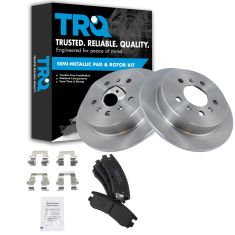
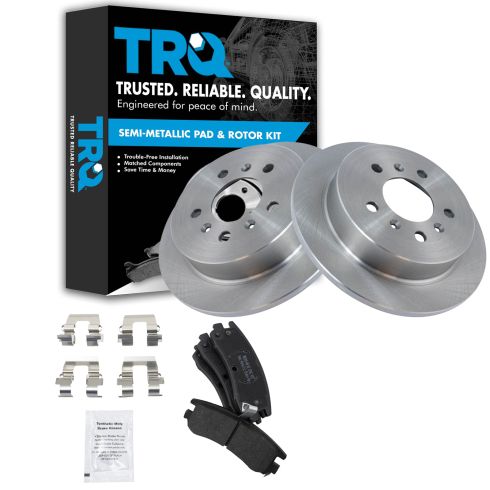
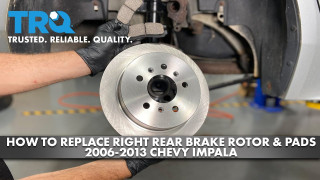
TRQ brake kits are designed to restore your brake system to like-new performance. TRQ brake pads are positive molded, thermal scorched, chamfered, and utilize a multi-layer shim for enhanced performance and service life. TRQ rotors have a non-directional finish that reduces the break-in period for new rotors as well as reducing vibrations throughout the rotor’s lifecycle. All products are fit and road-tested in our Massachusetts R&D facility to ensure we deliver on our promise of Trusted Reliable Quality.
Attention California Customers:
 WARNING: This product can expose you to chemicals including Lead and Lead Compounds, which are known to the State of California to cause cancer, and birth defects or other reproductive harm. For more information, go to www.P65Warnings.ca.gov.
Lifetime Warranty
This item is backed by our limited lifetime warranty. In the event that this item should fail due to manufacturing defects during intended use, we will replace the part free of charge. This warranty covers the cost of the part only.
FREE Shipping is standard on orders shipped to the lower 48 States (Contiguous United States). Standard shipping charges apply to Hawaii and Alaska.
Shipping is not available to a P.O. Box, APO/FPO/DPO addresses, US Territories, or Canada for this item.
Expedited is available on checkout to the United States, excluding Alaska, Hawaii.
Final shipping costs are available at checkout.
Created on:
Tools used
Brought to you by 1AAuto.com, your source for quality replacement parts and the best service on the Internet.
Hi, I'm Don from 1A Auto. I hope this how-to video helps you out, and next time you need parts for your vehicle, think of 1AAuto.com. Thanks.
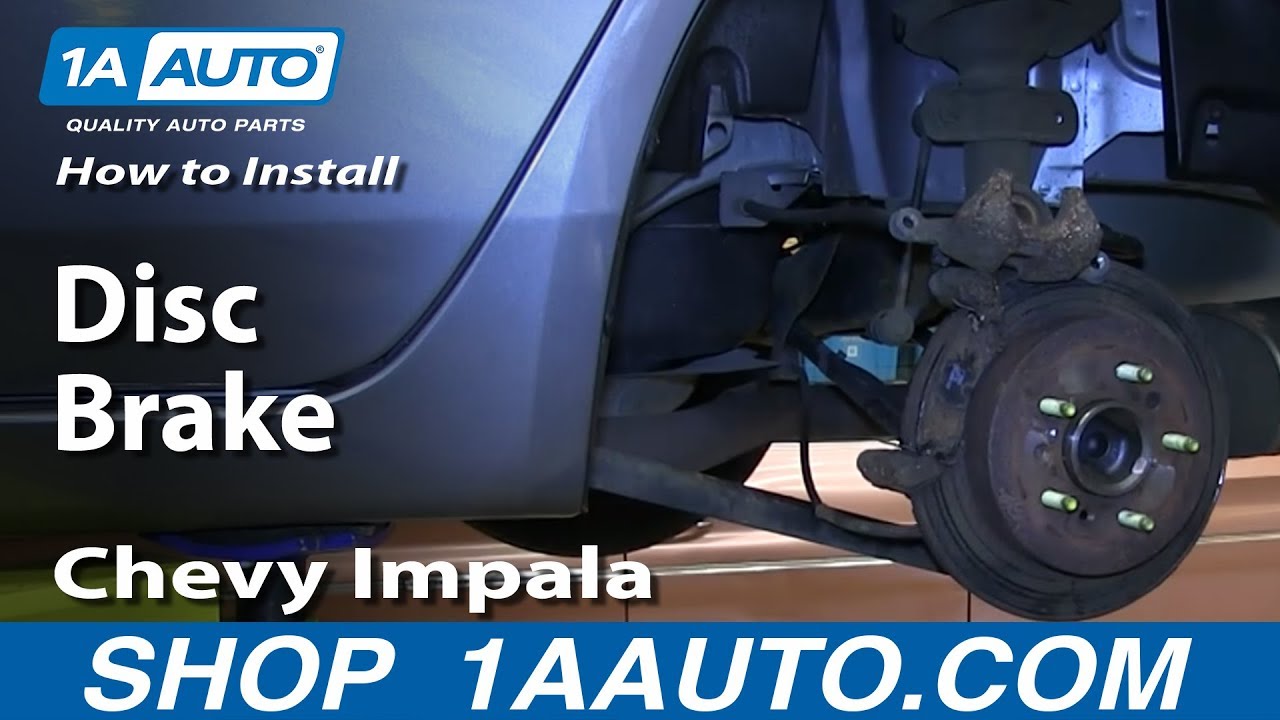
In this video, we're going to show you how to service the rear brakes on this 2006 Chevy Impala. We're going to show you the right hand or passenger side. It's the same procedure for the left hand or driver side. The brakes on this vehicle are in good shape, so we just take them apart and put them back together to show you. Tools you'll need are 13, 14, and 19mm sockets with a ratchet, a breaker bar or a pipe for extra leverage; T30 Torx bit; flat blade screwdriver; hammer; large C-clamp; wire brush; and jack and jack stands.
Start off by using a 19mm socket and loosen the black lug nut covers. Then this leads to taking the wheel cover off on this vehicle. It may be different on yours. If you don't have the benefit of air tools, you'll want to loosen the lug nuts, then raise and secure the vehicle, then remove the lug nuts the rest of the way and remove the wheel and tire.
You can inspect the brakes. The pads have good life on them on this vehicle. You'll also want to inspect the rotor. Just run the back of your finger or a small screwdriver. You're checking for any large grooves, even though these don't look too good they are in great shape, so we'll actually just take them apart and put them back together to show you.
Two 14mm bolts hold the caliper to the caliper bracket. I'm going to use a breaker bar; you can use a ratchet and a piece of pipe for some extra leverage to loosen those bolts. Finish removing the bolt, and then the caliper comes right up and off. Set it up top. Then you can just pull your pads right out. Pull out the inside and the outside, and then there are slides that you want to pull off of the caliper brackets. You'll want to clean those up later.
Then there are two 13mm bolts that hold the caliper bracket right there. Again, you'll want a breaker bar or a piece of pipe for some extra leverage. We'll fast forward as we undo those. As you remove that bolt, then that caliper bracket will come up and off. Now, use a T30 Torx driver, and we recommend one that's on a ratchet like this style. It's a socket style. Hold it in place with the screwdriver, and then remove the screw that holds the rotor on place. Once you get that screw off, you use a hammer and a good wrap should break the rotor loose. Just make sure your caliper doesn't fall down. Then you can pull the rotor off.
Now, we're going to prepare everything to go back together. As I said before, the brakes on this car were in good shape, so we're just going to put them back together. We're greasing the slide bolts that came out of the caliper bracket, and we're going to put a little bit of grease on the ends of the pads to make sure that they slide in the slides fairly well. Last but not least, we'll take a wire brush and we'll clean off those slides really well before we remount them. Here, we'll just use some brake parts cleaner to clean off the rotor a little bit.
Now we're ready to install. Put the rotor back on the hub. Reinstall that Torx 30 screw that holds the disc to the hub. Put the caliper bracket back in place, and reinstall the two 13mm bolts that hold it in place. We'll fast forward as we tighten those up. Now we're going to torque those to 75 foot pounds.
Now we can put those stainless steel slides back into the caliper bracket and reinstall our pads. Do the outer one first, it should press right in, and the inner one. When installing new pads, you'll need to reset the piston in the caliper, so use a large C-clamp and tighten down against the piston and drive it back into the caliper. Now, we can put the caliper back on top of the caliper bracket and pads, and start the bolts in. We'll fast forwards as we put those in. You'll want to tighten them to 60 to 65 foot-pounds.
Now we can keep the speed going as we put the wheel back in place, put the lug nuts on, and tighten them preliminarily. With the vehicle back down on the ground and secured in place, torque the lug nuts to 100 foot-pounds using a star pattern. Once you have them torqued, then you can put the wheel cover, or cap, back on and put that back in place. Just use your hand and a socket to tighten up those lug covers.
Last but not least, always make sure you get in and pump the brake pedal a bunch of times and make sure you get a nice firm pedal before you road test the vehicle.
We hope this video helps you out. Brought to you by www.1AAuto.com, your source for quality replacement parts and the best service on the Internet. Please feel free to call us toll-free, 888-844-3393. We're the company that's here for you on the Internet and in person.
Tools used
Brought to you 1AAuto.com your source for quality replacement parts and the best service on the internet.
Hi, I'm Mike Green. I'm one of the owners of 1A Auto. I want to help you save time and money repairing and maintaining your vehicle. I'm going to use my 20 plus years of experience restoring and repairing cars and trucks like this to show you the correct way to install parts from 1aauto.com. The right parts installed correctly. That's going to save you time and money. Thank you and enjoy the video.
In this video, we're going to show you how to remove and replace the front brakes. I found that this car actually has fairly new front brakes on it, so we're not actually putting new parts on it, just showing you how to take them off and putting them back correctly.
This process is the same for all 2000 and 2005 Impalas, and it's similar for a whole bunch of different cars that have front disk brakes, flat blade screwdrivers, a large size, 15 millimeter, 19 millimeter socket and ratchet, which obviously can be different per vehicle. A breaker bar or pipe, you might need that for leverage, and the torque wrench to get it back together correctly.
First use a screwdriver to remove the center cap. This car has aluminum wheels. If you have a hubcap it might be a little different. You may need to use a wrench to loosen up your lug nuts first while your wheels on the ground, then raise and support your car, and always follow the instructions with the jack and jack stands to jack a car. You can either place a jack or place your jack stand. You can also jack right up here onto the sub frame where the two beams meet.
I have the fortune of having air tools, so I'm going to use them. Just remove the wheel here. You can also use just turn the steering wheel and turn your wheel so you can access the brakes easily. To remove the calipers, you're going to remove two 15 millimeter bolts, one down there and one right up there.
Before you do that, you take a screwdriver or a large pry bar and put it in this hole. If your brakes are worn down more than on this car, you may have to use more angle but then you pry out and that helps to push your piston down into the caliper and makes it easier to get the caliper off.
Now, I'm going to remove those two bolts, and they shouldn't be too tight. They're usually tightened up to about 50 to 60 foot pounds, and we're going to speed it up here.
Depending on how much you pushed the piston back in, you can pull the caliper up and off. Have a screwdriver handy as I now appear with one, and just use a screwdriver to pry off the caliper and put it up top for now. Be careful not to stress your line and then the brake pads just come right off. They just pry right out of the caliper bracket.
Actually, this car has new brakes on it. I'm doing this to show you, but to remove the hub, you remove the caliper bracket by removing those two bolts, and those again are 15 millimeter bolts. You can't quite see it, but I did secure my caliper up top with a wire tie, and now I'm going to use my ratchet and a big piece of pipe.
That pipe helps me get leverage and I'm just going to pull nice and easy. I just keep applying pressure until that bolt breaks loose. Get it going some, and then I'll do the same thing up top. I'll keep continuing to add torque until it breaks loose and get it going and then I'll drop my pipe and just use my air tools to zip them out the rest of the way.
Now my caliper bracket comes up and off, and then, your rotor just comes right off like that. Now here, obviously, the rotor just goes back onto the hub and then I'll hit fast forward. I just use a lug nut to hold the hub in place while I put the brakes together.
We'll grab our bolts, and I got the large 15 millimeter bolts and put the caliper bracket on. Here is just a view from the front so you can see the caliper goes on the opposite side of the steering knuckle, closer to the rotor, and then the bolts go into it.
Now, we want to get those tightened and then tighten them up to 90 foot pounds using a torque wrench. The caliper brackets are stainless steel clips. They're slides. They pull off, and then you want to use a wire brush and just clean those up.
Those are what the calipers slide back and forth in, and then once you clean them up with the brush you can clip them back on. Obviously, this could be done with the caliper bracket off, but if you're just replacing your pads, you want to do it this way.
Now, take your pads, and they basically just slide right into those clips. There's the front side. You put them down into one side first, and then slide them into the other side, and then we'll put the back side in.
Now you want to pull your caliper down and use a large c-clamp. What I'm doing is forcing the piston all the way back into the caliper. If we slope back down here, you can see that piston with the clamp is pushing in is going back into the caliper. You do this and reset it. It lets you put your brake pads on or it lets you get the caliper down onto the brake pads very easily.
It's very important that when you put your vehicle back together, before you drive it out on the road, you want to pump your brakes about four or five times. That allows the piston to work its way back out to the proper place.
You want to make sure you pump your brakes, make sure it holds the car in gear and then do a stop from like 5 miles an hour and 10 miles an hour. Make sure the brakes are working before you drive it on the road.
Now, you can put your caliper down onto your pads. I'm just going to put that clamp down, and there are the little boots that are on the caliper bracket. You squeeze those down as you put the caliper onto the bracket. Then you grab your long bolts. These are pretty clean and well-lubricated. What you want to do is make sure you clean them off a little bit, put some grease on it, just a little bit, a sparing amount. They should slide in nicely. You might have to just kind of move those rubber boots around a little bit and work them in, and then start them by hand.
We'll fast forward as we're just putting those two caliper bolts on. I'll slope back down here. We're using a torque wrench and we're going to torque this bolts up to 50 foot pounds.
Back to fast forward here as we finish up torqueing up those bolts. Once those are done, then you want to remove that lug nut that's holding the rotor, and then you'll spin your wheel straight so it makes it easier to get the tire back on.
Now we'll put the wheel back on and you want to start all the lug nuts by hand so you don't cross-thread them, then you use your wrench or even just by hand. You just want to get the lug nuts preliminary tightened up, just so they kind of hold the wheel in place, and then you'll torque them after you let the car down back onto the ground.
We're back on the ground. We're going to torque our lug nuts to a 100 foot pounds, and you see I'm using a star pattern, basically drawing a star as I torque the lug nuts. Now we'll install our cap, and again, a very important note. Make sure whenever you do work on your brakes, get in your car, pump them a bunch of times first.
Make sure the pedal goes solid again then do a stop from like 5 miles an hour and 10 miles an hour. Before you go out on the road, make sure your brakes are working properly.
We hope this helps you out. Brought to you 1AAuto.com your source for quality replacement parts and the best service on the internet.
Please feel free to call us toll-free 888-844-3393. We're the company that's here for you on the internet and in person.

BKA11607