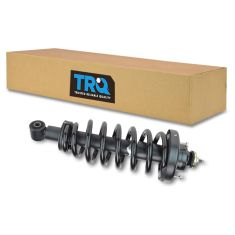
Replaces




Frequently bought together
About TRQ:
TRQ is a trusted brand dedicated to making every repair a success story by combining premium parts with easy installation. Each TRQ part is engineered by a team of automotive experts to meet or exceed OEM standards, delivering enhanced performance and maximum longevity. With rigorous in-house testing, the brand ensures superior fit and function across every product line. TRQ also provides customers with best-in-class, step-by-step installation videos—so you can complete repairs with confidence, whether you're a first-time DIYer or an industry professional.
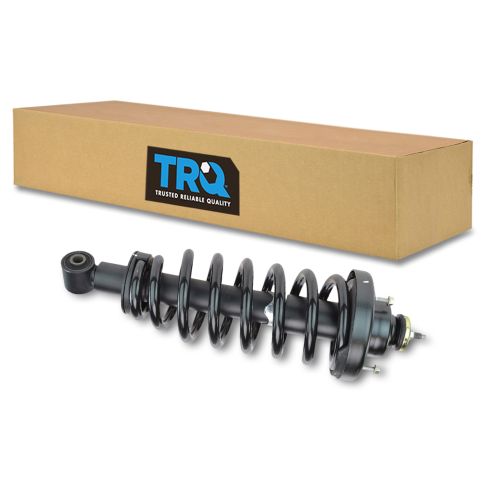
Replacing struts used to require specialized tools to compress, remove, and transfer the old spring and mount. Our Pre-assembled, complete strut & spring assemblies come with all new parts and make the job much quicker and easier for the do-it-yourself mechanic.
Strut & spring assembly contains:
Install Tip: To keep your vehicle operating safely and as designed:
Attention California Customers:
 WARNING: This product can expose you to chemicals including Chromium (Hexavalent Compounds), which is known to the State of California to cause cancer, and birth defects or other reproductive harm. For more information, go to www.P65Warnings.ca.gov
Lifetime Warranty
This item is backed by our limited lifetime warranty. In the event that this item should fail due to manufacturing defects during intended use, we will replace the part free of charge. This warranty covers the cost of the part only.
FREE Shipping is standard on orders shipped to the lower 48 States (Contiguous United States). Standard shipping charges apply to Hawaii and Alaska.
Shipping is not available to a P.O. Box, APO/FPO/DPO addresses, US Territories, or Canada for this item.
Expedited is available on checkout to the United States, excluding Alaska, Hawaii.
Final shipping costs are available at checkout.
Created on:
Tools used
Hi, I'm Mike from 1A Auto. We've been selling auto parts for over 30 years. We're dedicated to delivering quality auto parts, expert customer service, fast and free shipping, all backed by our 100% satisfaction guarantee. Visit us at 1AAuto.com, your trusted source for quality auto parts.
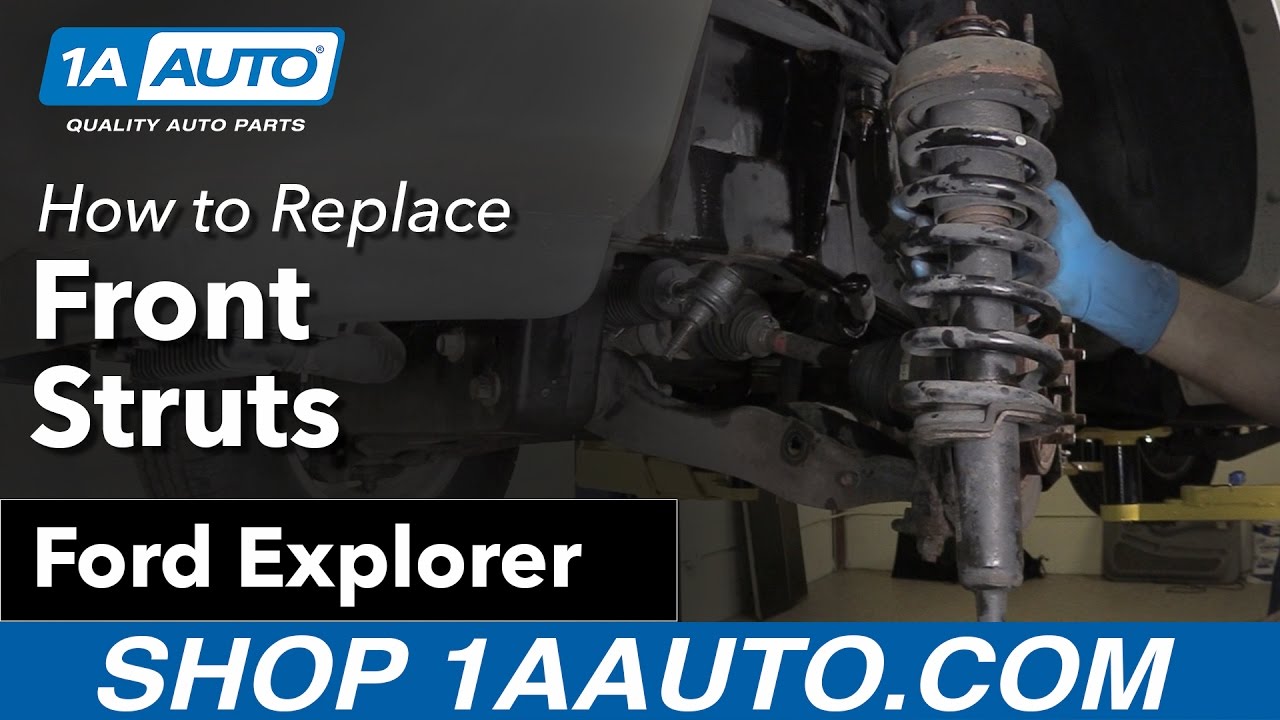
Using the 19 millimeter socket and a breaker bar, loosen the lug nuts on your tire. Raise and support your vehicle. We're doing this on a lift to make it easier to show you what's going on, but this job can be done at home on a jack and jack stands. Finish removing your lug nuts. You should be able to do this by hand at this point. You can use a ratchet if you need to. You can then remove your wheel and tire.
It may be a good idea to apply some penetrating oil to whatever parts you're going to be working with. There are three 13 millimeter nuts on the top of the strut that you'll need to remove. There's also a little plastic harness retainer here that you can just pop off with either a trim tool or a small flat blade screwdriver. Once that's out of the way, unless you have a very low profile socket ratchet, you'll need to remove the nuts with a 13 millimeter wrench. If you have a ratcheting wrench, now is an awesome time to utilize it.
Loosen and remove the 24 millimeter bolt on the bottom of your strut. This has what's called the flag nut inside the control arm, so there's actually a little leg on it that'll jam against the control arm and prevent it from turning. You're going to start this with the breaker bar because they tend to be pretty tight. Once we get it moving, we'll switch over to a ratchet. Be ready to catch the flag nut once you've backed the bolt out enough. Hold on to the strut while you work the bolt out of the bar. You may want to use a pry bar for this, but you can do it by hand. Just find a good place to get in there and bring the control arms down so you can lift the strut up.
Once you got the bottom of the strut out of the control arm, sometimes you may need to undo the 21 millimeter nut on your outer tie rod. To avoid damaging the tie rod end, hit the side of the knuckle in order to release it and remove your strut from the vehicle.
Now, depending on your specific vehicle, you may need to remove the upper ball joint from the knuckle to get enough clearance to install your new strut. We're installing a loaded one, so it's actually a little bit taller than our older one was because it had sagged from being on the truck for so many years, so we're obviously going to replace both sides to make sure we keep our ride height level. We're also going to undo this 18 millimeter nut with a socket and ratchet and then hit it with a hammer and release it from the knuckle, just like we did for our tie rod end.
We should now be able to install the strut nice and easy. Start the three 13 millimeter top nuts by hand. Reinstall your 24 millimeter nut into the bottom of the strut. You may need to lift up on the lower control arm and use the socket and ratchet to help center it and set it back in part way. Then we'll get your flag nut on there. Hold that while you get the bolt started. Bring the bolt down close, but don't tighten it yet. We want to wait until we have the weight of the vehicle on the suspension before we twerk all of our hardware. Tighten the three 13 millimeter nuts down with your 13 millimeter wrench low profile socket and ratchet or ratcheting wrench, depending on what you have available. Once you've got the nuts tightened down, if you used a ratcheting wrench, I recommend using a standard box end to finish tightening them down because the ratcheting wrenches don't tend to be super strong for high torque and they're usually a little bit shorter, so double check them with a box end and then reinstall the retainer plastic on the rear two bolts.
Using a screw jack if you're on a lift, or a standard floor jack if you're working on the ground, put the weight of the vehicle onto the suspension. This will also get you close enough to install the upper control arm. Get that 18 millimeter bolt started. Using the 18 and an eight millimeter wrench, the 18 on the nut and the eight millimeter on the shaft of the ball joint, hold that while you tighten it down. Once you get it snug so the tapered portion is seated back in the knuckle, you should be able to get your ratchet on there without it spinning. Torque the nut to 41 foot-pounds.
Install your tie rod into the knuckle. If you seated in there fully, that should prevent it from spinning while you reinstall your 22 millimeter nut. Tighten that down with a 22 millimeter socket ratchet. Torque the nut to 52 foot-pounds.
Reinstall the wheel and tire onto your hub. It's easiest to put a lug nut inside of the 19 millimeter socket to start it onto the studs. Get all five of these down as tight as you can by hand and then we'll torque the wheel once there's some weight on it. Lower the vehicle back down and put partial weight onto the wheel of the tire. This means that you may have your jack or lift under the vehicle. Ge the tire to touch and let the vehicle come down some without allowing it completely off of the lifter jack. Torque your lug nuts to a hundred foot-pounds in a cross pattern.
Thanks for watching. Visit us at 1AAuto.com for quality auto parts, fast and free shipping, and the best customer service in the industry.
Tools used
Hi, I'm Mike from 1A Auto. We've been selling auto parts for over 30 years. We're dedicated to delivering quality auto parts, expert customer service, fast and free shipping, all backed by our 100% satisfaction guarantee. Visit us at 1AAuto.com, your trusted source for quality auto parts.
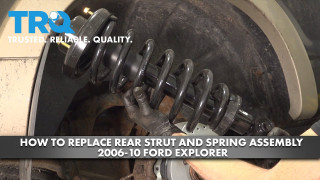
In this video we're going to show you how to replace the rear shock, and actually it's a rear strut and spring assembly. This is a 2006 Ford Explorer, pretty much the same for this generation of Explorer. We hope you like the video. If you do, click subscribe. Click subscribe even if you don't like the video. Also check out 1AAuto.com in the link below. You can find the parts in this video as well as check out all the other parts that we have available for Explorers and all kinds of vehicles. Here are the items you'll need for this repair.
With the vehicle on the ground, take a 19 millimeter socket, or your tire iron, and loosen up your lug nuts. Raise and support your vehicle, you can use jack and jack stands; we are using a lift. Remove the lug nuts the rest of the way, and remove the wheel and tire.
Spray the top of the stabilizer link with some penetrating oil. Let it sit. There's a 16 millimeter bolt that is the stabilizer link on the bottom. You need to hold that with a socket and ratchet. 15 millimeter is the nut on top. Take the nut off the top, and that'll allow your control arm to drop down. I'm just going to raise up the lower control arm a little bit to take some of the pressure off, and this just makes it so it doesn't pop when you take it apart. Our vehicle's on a lift, so we're using a heavy screw jack, obviously if your vehicle was on jack stands you'd use your floor jack and just raise it up a little bit.
Spray the lower bolts, and then up top there are three smaller bolts that hold the strut at the top. The outer one is a 24 millimeter bolt and you'll want to use a nice big bar for leverage. Loosen that up. For the inner one that goes through the bottom of the strut, hold the nut with the 24 millimeter wrench, or another socket and ratchet, and again use a large bar, and loosen up, then you can remove that nut. Get switched up here with socket on that side, and the wrench on the bolt side.
I'm also just going to spray and loosen that inner bolt and nut. Using a 24 millimeter wrench and socket on the other side, just loosen it up a couple of turns. Okay, now you can kind of slowly take the jack out while you're pulling this bolt, and also let it down and your strut bolts should come out too. A hammer is going to help that effort.
With a 13 millimeter wrench, loosen up each one of them first. Then once they're loose, a lifesaver of a tool here is a ratcheting wrench. Ours are in pretty good shape, but a lot of times these are very rusted, and when they're very rusted, a lot of times what a shop will do is either just cut these off with a torch, or a reciprocating saw, but ours are coming off easily. We'll remove these two back ones, and then take this one off but put it back on just finger tight to hold it in place.
Before we separate the lower control arm, we're just going to support the suspension here. You can remove this bushing, although it will come off on its own. Then lift up, remove that last nut, and the strut comes down.
We are reinstalling our original strut. This video is to show you how to do it. We didn't have a new one available at the time, but you want to put it up and in. Make sure when you put it up in there,that the strut is facing basically front to back, to go into the control arm.
Fit it in, and start putting your nuts on. Get all three in place then you can tighten those up preliminarily. While you can still move the strut around, bring your control arm back up. For the stabilizer link, if it's kind of rusted in place like ours is, just push it back up into the stabilizer bar. While the strut will still move around, I'm just going to lift my suspension up out of the way so it's easier for me to move the control arm into place. Get the bolt in, and then I can lower this down, and then I'll swap the jack onto the control arm and get this together.
I'm tapping on the top just to bring it down into place. The front side's in, but the control arm's not quite seated yet. Push in on the bolt. Make sure that once you get the bolt on, it turns into this nut that's set into the control arm. We'll put this nut on, we'll tighten that preliminarily, and tighten this bolt preliminarily. We'll lift it and support it in ride position before we torque them.
Remove this, and now we're just going to get support out here at the knuckle. Do not go all the way up, we just want to go up enough so that we can torque the three nuts on top. So make sure that there's some weight on the spring. Once you see the strut going up in, that's enough for now. The technical spec for these is 22 foot-pounds tight. With a small wrench like this, get them nice and tight if you don't have a torque wrench that would fit in here.
Now we want to raise our suspension up to the ride height, so basically raise your suspension until the weight's off your jack stand or your lift. Now you want to torque these to 203 foot-pounds, 203 foot-pounds, and 185 foot-pounds.
Then you can put your stabilizer link bushing back on, and the nut. We want to tighten the link, so I'm just going to remove my jack from here, and I'm going to place it over here just so I can get to that link bolt better. The nut is 15 millimeters, and this bolt is 16 millimeters, and we'll tighten these preliminarily and you want to torque it to 22 foot-pounds. Make sure it's all together correctly, the bushings have gone down into the stabilizer bar, and tighten it to 22 foot-pounds.
Reinstall your wheel and tire. With the vehicle back on the ground, you want to tighten your lug nuts to 100 foot-pounds using the star pattern.
Thanks for watching. Visit us at 1AAuto.com for quality auto parts, fast and free shipping, and the best customer service in the industry.

SCA57577