Replaces




Frequently bought together
Part Details
About TRQ:
TRQ is a trusted brand dedicated to making every repair a success story by combining premium parts with easy installation. Each TRQ part is engineered by a team of automotive experts to meet or exceed OEM standards, delivering enhanced performance and maximum longevity. With rigorous in-house testing, the brand ensures superior fit and function across every product line. TRQ also provides customers with best-in-class, step-by-step installation videos—so you can complete repairs with confidence, whether you're a first-time DIYer or an industry professional.
Product Features
Attention California Customers:
 WARNING: This product can expose you to chemicals including Lead and Lead Compounds, which are known to the State of California to cause cancer, and birth defects or other reproductive harm. For more information, go to www.P65Warnings.ca.gov.
Lifetime Warranty
This item is backed by our limited lifetime warranty. In the event that this item should fail due to manufacturing defects during intended use, we will replace the part free of charge. This warranty covers the cost of the part only.
FREE Shipping is standard on orders shipped to the lower 48 States (Contiguous United States). Standard shipping charges apply to Hawaii and Alaska.
Shipping is not available to a P.O. Box, APO/FPO/DPO addresses, US Territories, or Canada for this item.
Expedited is available on checkout to the United States, excluding Alaska, Hawaii.
Final shipping costs are available at checkout.
Created on:
Tools used
Brought to you by 1AAuto.com, your source for quality replacement parts and the best service on the Internet.
Hi, I'm Mike from 1A Auto. I hope this how-to video helps you out, and next time you need parts for your vehicle, think of 1AAuto.com. Thanks.
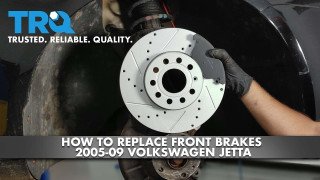
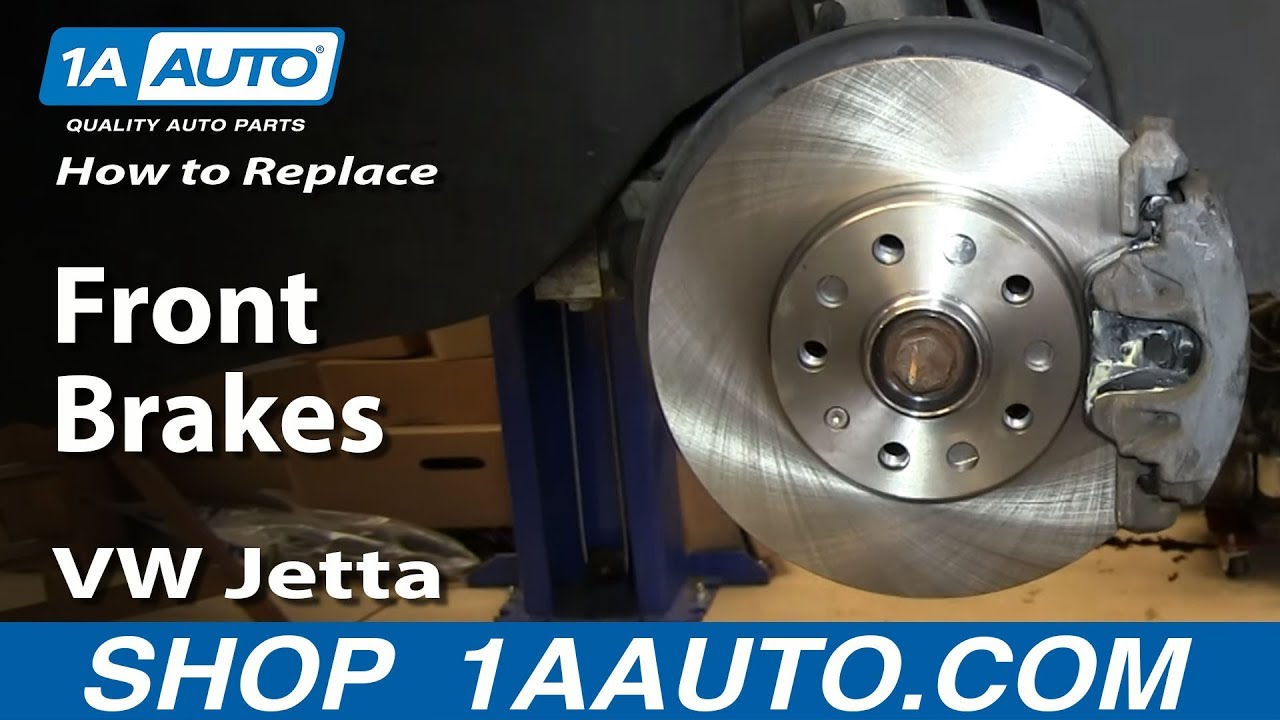
In this video, we're going to show you how to replace the front brakes on this 2005 Volkswagen Jetta. It's the same part and similar process on these Jettas from 2005 to 2006. We show you on the passenger side, but the driver side is the same procedure. The items you'll need for this is a new front brake pad and rotor kit from 1AAuto.com, 17mm and 21mm socket and ratchet, a flat blade screwdriver, a pick, a T30 and T47 Torx bit, a hammer, jack and jack stands, wire brush, large C-clamp, brake grease, and a torque wrench.
Use your pick remove these caps. For one of these lug nuts, you're going to have to use a key. The key can be found in your trunk with the spare tire. It inserts into that special lug nut, and then removes the same as the other lug nut using a 17mm socket. If you have air powered tools, you can raise your vehicle and then remove the lugs nuts. If you don't, loosen the lug nuts while the vehicles on the ground. Then raise and support the vehicle and remove them the rest of the way. Then your wheel will pull free.
Now we can inspect our brakes. You want to see if there are any large grooves or anything in the rotors. These are actually pretty smooth, but on the other hand here's the metal pad, here's actually the friction part. That's very thin, and then there's your rotor. The pads on this actually need to be replaced.
First thing we're going to do is pry out the little plugs here. Then there are Torx bits in there. There's this one here and this one down here as well. We'll fast-forward as Mike removes those two T47 bolts. Using a flat blade screwdriver, pry out this wire clip and pull it free. Just to get things off easier, take a large screwdriver and pry a little bit. Pull your brake caliper off, and this first brake pad will pull right out. This one, pull out on either side of it and it will pull out of the piston. Now remove these two 21mm bolts. You can see Mike uses a piece of pipe for some extra leverage and removes those. Once those are removed, your caliper bracket will pull free.
Now remove this T30 screw at the front of your rotor. Spray some penetrating oil around the edge here where the rotor meets the hub, and then twist in one of these lug bolts half way. Then, using a hammer, hit the back of the rotor until it breaks free. Then remove that lug bolt and your rotor will pull off.
On the right is the old rotor and brake pads; on the left is the new ones from 1A Auto. You can see they're identical, and will fit exactly the same. Take your new rotor and push it into place. Then replace that T30 screw to hold it in place. We'll fast-forward as Mike tightens that up. Using a wire brush, clean the brake caliper bracket in the areas where the pads come in contact.
Take your caliper bracket and put it back into place. Replace those two 21mm bolts and tighten them up. Torque each of those 21mm bolts to 90 foot-pounds. Using a large C-clamp, push the piston on the caliper back in. Then push these brake caliper slides back. Put some brake grease on the backs of the pads, and then in where they're going to hit against the caliper bracket. Using a socket, set that inner bracket in. The other one goes right down in, there we go. Now tighten up those two T47 screws, and torque each of those to 30 foot-pounds. Push the wire clip back into place. Replace these two caps.
Replace your wheel, and you'll realize here that lug nuts are a bit easier than lug bolts. You have to try to hold the wheel in place while you put a lug bolt through. You want to balance it on the hub, and eventually the bolt will line up and push in. Then you want to tighten those preliminarily, and replace and tighten up each of those. Then lower the vehicle and tighten them up the rest of the way. Torque each of these to 100 foot-pounds in a crossing pattern, and replace your lug nut caps.
After doing work on your brakes, you want to pump the brake pedal until it firms up. Then do a stopping test from 5 miles per hour, and then 10 miles per hour.
We hope this video helps you out. Brought to you by www.1AAuto.com, your source for quality replacement parts and the best service on the Internet. Please feel free to call us toll-free, 888-844-3393. We're the company that's here for you on the Internet and in person.
Tools used
Hi, I’m Mike from 1A Auto. We’ve been selling auto parts for over 30 years!
All right, so we're going to take the tire off. On most Volkswagens, there's little caps that go over these lugs. The caps, you're going to need the tool from the spare tire kit. You'll put it in and grab. It's like a hook, and you'll pull the cap out, but this vehicle does not have those on currently. We're just going to loosen up the lugs with a 17 millimeter socket and a breaker bar, one at a time, just a little bit. When raising, jacking this vehicle, you're not going to want to use a jack or jacks stands on here on the control arms or on this aluminum, because you may break the aluminum or there. Some places, you can jack up from. It's over here where the pinch weld is.
On this Volkswagen, you can see there is specific spots where you're supposed to jack the vehicle or support the vehicle. These little arrows indicate that and right on the pinch weld. It's the strongest part to be jacking and supporting, and the same over here, this side. There's a little arrow pointing down. This one, it looks like it got smashed a little bit.
We're going to take off the lug, the lugs. Volkswagen has lug bolts, not lug nuts or lug studs. You need to be careful when pulling off the wheel. Then you grab the wheel, and it comes right down. Next, we're going to take off this retainer that holds the caliper to the bracket. You can use needle nose or a straight screwdriver. Pull that part out first, and it comes right off.
Now we're going to pull off the caliper slide bolts, but before we do that, there is these caps that go over. I believe this one has one missing, but we can just take a small screwdriver. Pry it out, and pull it off. Next we're going to use a 7 millimeter Allen and a ratchet to take out the caliper bolts. If it doesn't come out completely, that's okay. It just needs to be backed off so we can pull the caliper off. All right, on this vehicle, on the driver's side, sometimes they have pad sensors. This is the connector for the pad sensor. Before you pull the caliper off on the driver's side, you're going to want to disconnect this one. This one is actually broken, as you can see. But to release it, you could just slide that out. You can put a little screwdriver in here straight. Just bend it back slightly. You need to be careful, because the plastic might break. There we go. It clicked, and it's good.
Now we're going to pull off the caliper. You're going to pull straight back. You pull off the pad, one at a time. This pad comes out straight like that, because there's clips on it. There's the sensor. Then we're going to hang our caliper with a bungee cord so it doesn't fall. You don't want to put any strain on the brake line. Next, we're going to take this caliper bracket off. We're going to take off these two 21 millimeter bolts with a socket and a breaker bar. Get the two bolts loose. Once they're loose, you can do it by hand, or you can pull them out. You're going to take the bracket, slide it out towards the front of the car. Now we're going to want to separate our rotor from the hub. There is this little T30 screw. You're going to use a T30 bit, a Torx, and a ratchet. We're going to loosen it, holding the rotor. This one's pretty solid.
What we're going to do is we're going to put a lug nut in there. All right, because the rust has built up on the hub, it has caused the rotor to stick to the hub. What we're going to do, we're to break that rust free. We're going to use a hammer. We can hammer all around this area. If you are reusing your rotor, you would not want to be on the surface of the rotor. Sometimes they're tricky. Sometimes they're harder than that. In worst case, you use a bigger hammer or sometimes some rust penetrant. You can spray it in the holes and let it sit for a while. Then pull off the rotor.
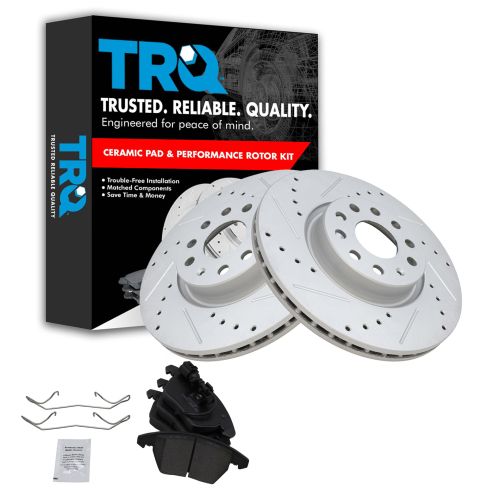
Here you can see the old part versus our new part from 1AAuto.com. You can see the pads are the same. This is the driver's side. The driver's side has a sensor in it. As you pull this out, you can see it’s the same as on the car. Pull this little tab. The connector slides out, the cover. As you can see, if you compare the two connectors, they're the exact same. If you look at the two brake pads, the brackets where they go into the caliper bracket are the same.
The two rotors, you can see the size. They are the same. If you compare them, these ones are drilled and slotted for added cooling and performance. On the website, you can see which side goes on which. They are different, right to left. This one happens to be a driver's side.
All right, so we're going to clean up our caliper bracket. You're going to take a wire brush, and just get in here. This is where the pads will slide on the bracket. All right, before we put the new rotor on, we're going to have to clean this area of the hub. We're going to use a wire brush and make sure to get a good amount of the rust. All right, we're going to put the new rotor on and take a little Torx bolt. Screw that in.
Now we're going to reinstall our caliper bracket. Slide it over the rotor. All right, now we're going to install our caliper bracket bolts. Now we're going to torque our caliper bracket bolts to 155 newton meters on this vehicle. Now we're going to use some channel locks to compress the piston. We're going to do this very gently. You don't want to squeeze too hard. As we were squeezing this, we didn't have to go very far. Normally, if your brakes were really bad, this piston would be out further. When you compress this, this is pushing brake fluid up back into your master cylinder reservoir.
When doing this job, because we're not cracking any lines or taking off any components that have to do with that system, we do not have to bleed the brakes after finishing this job. You want to double check to make sure. You can check on our website. This is a driver's side rotor. As you can see, the fins are digging into the wind when the wheel is rotating.
That is how this rotor is supposed to be on this vehicle, but you can double check our website, 1AAuto.com. We're going to put a little brake grease on the sliding components of the brake pads and on the pad that's already in there. Good.
Then we're going to take our caliper. Keeping the pad sensor out of the way, we're going to slide on our caliper. You're going to take your caliper connector. It's the warning. When the brakes get thin, it will break the connection, and it'll tell you your brakes are thin. You plug that into there until it clicks. Then it'll slide right back onto the bracket.
All right, so we're going to put the caliper slide bolts in. What we want to do is take a little bit of brake grease and grease them up. I'm going to insert our caliper slide bolt. We're going to use a ratchet and our 7 millimeter Allen socket. We're going to torque these slide bolts to 15 newton meters. We're going to install this dust cap. It goes over where the caliper bolt goes in. Next, we're going to put this retainer that goes on the outside of the caliper. It keeps the caliper down where it's supposed to be on the pads. What I like to do is push down into the hole using needle nose. It seems to work best. We'll get it in that hole. Then you can push this spring on. Make sure you push it down.
Now we're going to install the tire, lining up with the holes, and hold it. We'll use our 17 millimeter socket to put our lug studs on, or lug bolts, whatever you want to call it. Put our center cap on. Now we're going to torque the lug studs to 120 newton meters in a star pattern. When you do it in a star pattern, it makes the wheel go flush to the brake loader properly.
Make sure that after you do a brake job, you make sure that you pump the pedal, because there is going to be an air gap between the caliper and the brake pads when you first start out. You want to make sure you get that caliper piston to go in. Whenever you change front end components or remove front end components and reinstall them, you always want to go to a local garage and have an alignment performed, because you are going to change the geometry of the wheel and tire going down the road. You do not want premature wear on your tires, so you want to make sure you do that. You'll be all set.
Thanks for watching. Visit us at 1AAuto.com for quality auto parts, fast and free shipping, and the best customer service in the industry.

BKA12496